Outer Banks septic guide
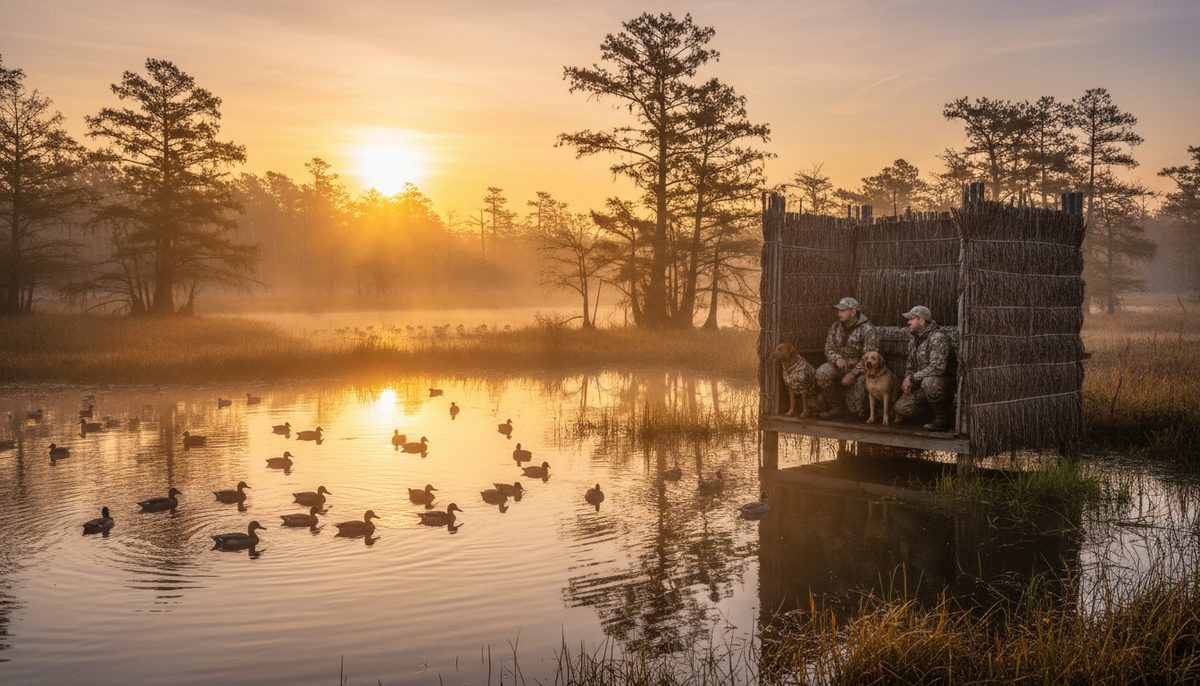
Duck hunting at Currituck National Wildlife Refuge
Nine permit blind locations on Currituck Sound, issued by the state commission rather than the refuge — and an access constraint by boat or 4WD that decides who can actually use one.
Winning the permit is the easy half of Currituck. The refuge sits north of Corolla on maritime forest and brackish marsh, and Currituck NWR access by boat or 4WD only — Monkey Island and Swan Island tracts only. There is no paved approach and no parking area at the end of a road. So the honest first question is not whether you can get a blind here, it is whether you can physically deliver yourself, another hunter, decoys and a dog to a marsh blind in the dark on the transport you actually own.
The details
The hunt itself is a genuinely good one and the numbers are published. Currituck NWR 9 blind locations, permit required — nine different waterfowl blind locations on brackish and freshwater marsh on Currituck Sound, accessible only by permit, with predominant harvested species listed as wigeon, gadwall, green-winged teal, black duck and tundra swan. That species list is worth reading twice, because it describes a puddle-duck and grass-feeding sound fishery rather than the big-water diver shooting people often picture when they hear Currituck.
The permitting is the part that sends hunters in circles, and it is a structural quirk rather than an oversight. This is federal ground, but Currituck NWR waterfowl hunting by NCWRC-issued permit: the waterfowl permits come out of the state commission's Permit Hunting Opportunities publication, not from the refuge. Search the refuge site for an application and you will not find one, because there is not one to find. Everything you need is in a state publication about a federal property.
Now back to the access constraint, because it is the thing that turns an exciting permit into a hard morning. Four-wheel drive here is beach and sand driving on the Currituck banks above the paved end of the road, which is its own skill with its own failure modes — tyre pressure, tide, soft sand, and a recovery plan that does not depend on a phone signal. By boat it is Currituck Sound in winter, which is shallow, wind-driven and capable of dropping a foot of water out of a run you crossed easily on the way in. Neither route is casual.
Plan the logistics before the calendar, then. Know which tract your blind sits on and which of the two access modes actually serves it. Have a second person who can drive the vehicle or run the boat, because a solo failure out there is a different category of problem. Go in daylight first, on a day you are not hunting, and find out how long the trip really takes with a full load rather than how long you assumed it would.
Two smaller things that separate the hunters who come back from the ones who do not. The nine blinds are fixed locations on a big sound, so wind direction determines which of them is worth being in far more than reputation does — learn the prevailing winter winds for this water before you form an opinion about which blind is the good one. And tundra swan appearing on the harvest list is a reminder that identification standards here are high; a bird you cannot name in poor light is a bird you do not shoot.
Nine blinds, a state-issued permit for federal marsh, and a trip that goes by boat or by 4WD or not at all. Solve the transport honestly first — the permit is the part you can win, and the access is the part that decides whether winning it was any use.
On the record: Currituck NWR 9 blind locations, permit required (NC Wildlife Resources Commission — Public Waterfowl Hunting Opportunities PDF, additional permitted-hunt table (ncwildlife.gov, retrieved 2026-09-17)) · Currituck NWR waterfowl hunting by NCWRC-issued permit (U.S. Fish & Wildlife Service — Currituck National Wildlife Refuge, Hunting Regulations library entry (fws.gov, retrieved 2026-09-17)) · Currituck NWR access by boat or 4WD only (U.S. Fish & Wildlife Service — Currituck National Wildlife Refuge (fws.gov, retrieved 2026-09-17)) · G.S. 113-291.1 shooting hours, half hour before sunrise to half hour after sunset (N.C. General Statutes § 113-291.1 (ncleg.gov, retrieved 2026-09-17))
Hand-verified 2026-09-17 against the primary sources named above; where a fact could not be verified it was left out, never guessed.